15 November 2009

Pentecost XXIV - Trinity XXIII

Pentecost XXIV - Trinity XXIII
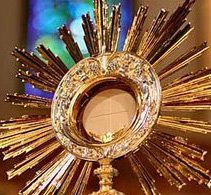
Adorate Deum
Proper 28, Year B

(RCL)1 Samuel 1:4-20 and 1 Samuel 2:1-10; Hebrews 10:11-14 (15-18) 19-25; Mark 13:1-8

    Introit: Adore God, all you His Angels: Sion heard, and was glad: and the daughters of Juda rejoiced. -- (Ps.96. 1). The Lord hath reigned, let the earth rejoice: let many islands be glad.

    Collect: Blessed Lord, who hast caused all holy Scriptures to be written for our learning: Grant that we may in such wise hear them, read, mark, learn, and inwardly digest them, that, by patience and comfort of thy holy Word, we may embrace and ever hold fast the blessed hope of everlasting life, which thou hast given us in our Savior Jesus Christ; who liveth and reigneth with thee and the Holy Spirit, one God, for ever and ever. Amen.

    Gospel: As Jesus was leaving the temple, one of his disciples said to him, "Look, Teacher! What massive stones! What magnificent buildings!" "Do you see all these great buildings?" replied Jesus. "Not one stone here will be left on another; every one will be thrown down." As Jesus was sitting on the Mount of Olives opposite the temple, Peter, James, John and Andrew asked him privately, "Tell us, when will these things happen? And what will be the sign that they are all about to be fulfilled?" Jesus said to them: "Watch out that no one deceives you. Many will come in my name, claiming, 'I am he,' and will deceive many. When you hear of wars and rumors of wars, do not be alarmed. Such things must happen, but the end is still to come. Nation will rise against nation, and kingdom against kingdom. There will be earthquakes in various places, and famines. These are the beginning of birth pains.

In T. S. Eliot’s poem, “The Four Quartets,” he talks about going to a church at Little Gidding, the site of a small Anglican religious community founded in the seventeenth century. Eliot writes, “You are not here to verify, instruct yourself, or inform curiosity or carry report. You are here to kneel where prayer has been valid.”
Many of us have felt this desire to kneel where prayer has been valid. For those of us who pray regularly, we may long to join our prayers to those who have gone before us. For those of us who have a hard time with prayer, we still somehow desire to kneel in that place where prayer has been valid. In either case, when we come into a place where truthful prayer has been made, many of us feel like falling to our knees.

People attend church services for a variety of reasons. The preaching. The music. The fellowship. The coffee hour. The stained glass windows. One extremely important reason people come to church is to kneel in a place where prayer has been valid. Somehow, we want to put ourselves in that place where truthful prayer has been offered. Even when we feel like we don’t have the words ourselves, perhaps especially when we don’t have the words ourselves, we want to go to that place and receive the sustenance that comes from being in a place where prayer has been valid. Our churches are many things, but one thing that seems essential is that it has been and continues to be a place where truthful prayer is made.

Our Old Testament lesson for today from the First Book of Samuel begins with the simple statement “Hannah prayed.” Such a simple statement, and yet encompassing such depths that we will never fully fathom in this mortal flesh. Archbishop Michael Ramsey was once asked how long he prayed each day, and he responded by saying, “Oh, I suppose only two or three minutes.” Then he added that he had usually been at his prayers in chapel for an hour in order to get to that two or three minutes of prayer.

The Catechism in our Book of Common Prayer gives us a nice introduction to the principal kinds of prayer. This is helpful because often times we think of prayer as simply asking God for things. And, indeed, these are valid prayers, prayers of petition and intercession in which we bring before God our needs and the needs of others. However, our Prayer Book deals with intercession and petition only after explaining prayers of adoration, praise, thanksgiving, penitence, and oblation – and the order may be telling us something important. Perhaps there is a reason that adoration and praise and thanksgiving are at the top of the list.

The Westminster Catechism says that the chief end of human beings is “to glorify God and enjoy him forever.” Notice it does not say the chief end of human beings is “to ask God for things and to keep asking for things forever.” It does not say “to confess our sins to God and to keep confessing our sins forever.” Rather, it says “to glorify God and to enjoy him forever.” When all those other types of prayer pass away, adoration and praise of God will continue forever. As valid as all other types of prayer are, someday they will end. Someday all prayers will be encompassed by adoration and praise.

As German theologian Gotthold Mueller wrote:

“Praise of God … according to the witness of both Old and New Testaments is the only form of prayer enduring ‘from ages to ages.’ As with faith and hope, all other forms of prayer (petition, intercession) come to their eschatological fulfillment and so to an end. What ultimately endures is the doxa (praise) of God which is, at the same time, the only true salvation of humankind and of the whole creation.”
What is the chief end of human beings? To glorify God and enjoy him forever.

What is amazing about prayers of adoration and praise is not only that they will endure from age to age, but also that we can participate in these prayers right now. And Hannah, in our Old Testament lesson for today, shows us how. Hannah’s prayer is a prayer of adoration and praise and thanksgiving. She prays, “My heart exults in the Lord.” Adoration. “There is no Holy One like the Lord, no one beside you; there is no Rock like our God.” Adoration and praise. “The Lord makes poor and makes rich; he brings low and he exalts. He raises up the poor from the dust; he lifts the needy from the ash heap, to make them sit with princes and inherit a seat of honor. For the pillars of the earth are the Lord’s and on them he has set the world.” Adoration and praise and thanksgiving. Hannah’s prayer then, now, and from age to age. Our prayers joined with Hannah’s, then, now, and forever.

Richard Foster in his book Prayer says that adoration is

“not a special form of prayer, for all true prayer is saturated with it. It is the air in which prayer breaths, the sea in which prayer swims. In another sense, though, it is distinct from other kinds of prayer, for in adoration we enter the rarefied air of self-less devotion. We ask for nothing but to cherish him. We seek nothing but his exaltation. We focus on nothing but his goodness.”
All true prayer is saturated with adoration.

We long to kneel in that place where prayer has been valid because in some way we know that when we do so we are joining in something that will endure from age to age. All true prayer that is saturated with adoration and praise and thanksgiving will endure forever. Perhaps that is why people still come to church services today.

To join in the prayers of our forbearers whose hearts exulted in the Lord, who praised God, and who gave thanks to God for his mighty acts of redemption.

To join in the prayers of all those ordinary and extraordinary saints who have gone before us who have lifted their hearts giving God their thanks and praise.

To join with the present company of the faithful, to add what God has done in our lives to the record of his mighty deeds in our own prayers of adoration and praise.

And to join our voices with angels and archangels and with all the company of heaven who forever sing hymns and proclaim the glory of God’s Name.

"You are not here to verify, instruct yourself, or inform curiosity, or carry report. You are here to kneel where prayer has been valid."

-- The Rev. Dr. Joseph S. Pagano is rector of Emmanuel Episcopal Church in Baltimore, MD. He received a Ph.D. in theology from Marquette University in Milwaukee, WI.

    14 November 2009

    The Anglican Covenant - the sound of silence

    One of TEC's shining stars for the past couple of decades is Louie Crew. He has been a tireless advocate for equal rights for all members of our church. Today he commented on the Anglican Covenant. He has graciuosly allowed me to post his thoughts on TTLS.

    I rejoice in your patient, painstaking attention to every jot and tittle of Wright's and Williams' statements. You undertake a very important task, one for which I personally do not have a calling.

    TEC has been careful and patient in our response to the demands made upon us by the Windsor Report, the primates, two Lambeth Conferences, and now the drafts of a proposed covenant -- even in the face of a louder and ever more strident cry from some quarters, "We have no need of you unless you repent and conform to our views regarding homosexuals!"

    ++Rowan has boxed himself in (he would say his role as Archbishop of
    Canterbury has thus situated him) to cut off any serious claim that he might have to a pastoral response to lgbt Christians. I used to feel that he needs to visit Samaritan wells, but he has long ago done so, and a friend of mine is even a "fairy at the bottom of his garden" quite literally.

    I was one of seven lgbt leaders with whom ++Rowan met privately at General Convention in Anaheim this summer: we each had a limit of 90 seconds to speak to him, and he spoke for no more than 5 minutes. Most of us described our ministries -- sharing the living water which has blessed us. We did not go away, as did our Samaritan ancestor, proclaiming,"He told me everything I had ever done!"

    Our Baptismal Covenant is enough for this and any conflict the Communion might have, but it is TEC's bounden duty to enter into the conversations about a proposed Anglican Covenant. Executive Council is right to take seriously all drafts. The proposed covenant is not the vehicle that I would personally have chosen for the conversations, but it is the main vehicle we have right now. Most hostile provinces have deliberately defaulted on their formal commitments to listen to lgbt persons.

    I find it interesting how few provinces of the Anglican Communion have responded to the drafts of the Covenant. Low response may derive from lethargy or possibly from an unwillingness to give the sexuality debate the attention that some have lavished upon it.

    The low response may also derive from a shrewd awareness that any new authority to force conformity on this issue may well bite back on other issues not now foreseeable.

    Bonds of affection have served us well in the Communion's history: juridical or curial pronouncements inhibit bonds of affection.

    Given other major crises of our time, it is not reasonable to think that conformity of practice regarding responses to lgbt Christians should have the high priority it would have were it to become the only issue on which the Communion has fundamentally changed the way it makes decisions and exercises authority.

    The Anglican Communion is a secondary result of colonialism. The sexuality debate derives much of its energy from the pain and injustice that colonialism long heaped on those who have only recently become a numerical majority of the Communion. I rejoice in their opportunity to flex their ecclesial muscles, and I am not surprised that they have chosen to do so on a subject that they think is not present among them, at least not present in a way likely to surface among their leadership.

    As recently as 1979 TEC's House of Bishops officially held the views of Lambeth 1998 on this subject, and many, perhaps most, of those voting thought that the "issue" and lgbt Christians were not coming near their congregations or dioceses. Yet behold: "Yoo-hoo. Hi there! Helloooow? Yo bro!"

    We don't need divine intervention to help us cope with these challenges: God already has given all that we need: be kind to one another, tender-hearted, forgiving one another, even as God for Christ's sake has forgiven an old queen like me.

    Joy!
    Louie


    Well said, Louis.

    12 November 2009

    Superior Court rules in favour of Diocese of San Diego

    In another ruling favouring The Episcopal Church, the San Diego Superior Court ruled in favor of the Episcopal Diocese of San Diego on November 10.

    This time, the dissenting congregations in the San Diego Diocese were members of St. Anne's in Oceanside and Holy Trinity in Ocean Beach. In 2006, leaders of these congregations renounced their membership in the Episcopal Church. They then began their open dispute with the Diocese of San Diego regarding who owned the property.

    Tuesday's ruling leaves no doubt that the diocese owns the property.
    According to the Bishop Mathes,
    While I know this comes as a hard decision for the members of these dissenting congregations, this is also an opportunity for reconciliation and renewal. We are eager to welcome these individuals back into the Episcopal Church. There is no need for anyone to change their place of worship. We will celebrate the same service from the same prayer book at the same altar.
    And that's the way it is. Even mad bulls give up, eventually. One must wonder how long the schismatics can keep funding the sinking ship of schism.

    08 November 2009

    Pentecost XXIII - Trinity XXII

    Dixit Dominus
    (RCL) Ruth 3:1-5; 4:13-17 and Psalm 127; Hebrews 9:24-28; Mark 12:38-44

      Introit: The Lord saith: I think thoughts of peace, and not of affliction: you shall call upon Me, and I will hear you; and I will bring back your captivity from all places. -- (Ps. 84. 2). Lord, Thou hast blessd Thy land: Thou hast turned away the captivity of Jacob.

      Collect: O God, whose blessed Son was manifested that he might destroy the works of the devil and make us children of God and heirs of eternal life: Grant us, we beseech thee, that, having this hope, we may purify ourselves even as he is pure; that, when he shall appear again with power and great glory, we may be made like unto him in his eternal and glorious kingdom; where with thee, O Father, and thee, O Holy Ghost, he liveth and reigneth ever, one God, world without end. Amen.

      Gospel: As he taught, Jesus said, "Watch out for the teachers of the law. They like to walk around in flowing robes and be greeted with respect in the marketplaces, and have the most important seats in the synagogues and the places of honor at banquets. They devour widows' houses and for a show make lengthy prayers. These men will be punished most severely." Jesus sat down opposite the place where the offerings were put and watched the crowd putting their money into the temple treasury. Many rich people threw in large amounts. But a poor widow came and put in two very small copper coins, worth only a fraction of a penny. Calling his disciples to him, Jesus said, "Truly I tell you, this poor widow has put more into the treasury than all the others. They all gave out of their wealth; but she, out of her poverty, put in everything—all she had to live on."

    No, this isn’t a sermon about tithing, so you may take your hands off your wallets.

    Our television screens bombard us with offers of deals. No doubt your spam contains similar offers. From time to time we read about elderly people who have been duped out of their funds by unscrupulous people offering deals. There are even crooks who recently played with peoples’ health by offering spurious swine-flu remedies. So we build walls around our lives, taking care not to be “had.”

    It is easy for us to become so protective of ourselves that we are no longer able to give or receive easily. Those of us who have been hurt badly build walls around ourselves and then wonder why we are so lonely and unfulfilled. Christians are not immune to this “natural” reaction.

    Sometimes we don’t give to worthy charities, excusing ourselves by muttering that they spend too much on overhead. And yes, we get moody when the annual pledge campaign hits us in our parish. The odd thing is that we don’t feel our consciences tugged when we read the sort of lessons appointed for this Sunday.

    The story of Ruth is a non-Jewish love story. Ruth takes a leap of trust and faith and decides to stay with her mother-in-law and marry Boaz rather than retuning to the safety and security of her own homeland.

    In Kings, a woman left with nothing to feed her son and herself feeds the Prophet with what she has left. She may starve to death, but still she makes bread and gives drink.

    In the gospel Jesus points to a widow woman, obviously without children to care for her. She gives her last penny. In the light of what Jesus says later about the scams going on in the Temple, the fact that he commends the widow for giving all she has to the Temple treasury is astounding.

    Surely Ruth should have required a prenuptial contract! Surely the poor woman should have told the Prophet to go and find her son and her something to eat. Should not Jesus have rather suggested that the widow keep her few cents for herself? “Charity begins at home!”

    Protecting our assets, the things we cherish, our integrity, seem to be natural reactions, survival instincts. Yet we follow a Savior who calls us to risk all in order that we may truly love and be truly whole. It would be said of Jesus, “The foxes have lairs, the birds of the air their nests, but the Son of Man has nowhere to lay his head.” Jesus’ mother and his relatives pleaded with him to come home, to be safe and to stop living so dangerously. The love of Jesus was extravagant, self-sacrificial, and utterly without concern for his own well being.

    Well, we think, that is fine for Jesus, but he is unique. Sometime early on we absolve ourselves of commitment to follow his example, and settle for a faith that allows him to do the sacrificing, while we receive the benefits.

    In the gospel, Jesus points to professionally religious people who parade their religiosity and who love the power their religious rank gives them, but who defend their institution and their place in it vigorously. When the Chief Priest decided that Jesus must be killed, he justified it as the death of one to protect the peace and prosperity of the settled religious Establishment. “It is expedient that one should die for the people.”

    How often we rephrase Jesus’ command to “Go Baptize, Go Tell” with “Come through our church doors and help us maintain the building!”

    Christianity calls us to love extravagantly, care extravagantly, and give extravagantly. Saints such as Francis of Assisi took that challenge to heart, to the dismay of his parents and the contempt of the world.

    One of our lovely Collects contains the phrase “In whose service is perfect freedom.” Remember “service” once meant slavery. Jesus, we are told by St. Paul, gave up his equality with God, emptied himself, and became a servant, a slave.

    That’s wonderful. Jesus is our servant. Just what we need.

    But what of us? How do we measure up “to the fulness of the stature of Christ?” Do you remember when your parents used to put you against the wall and mark how tall you were growing? Next to Jesus we seem small in love, in caring, in giving. Yet if we are to commend our faith, our parish, our Church to a needy world and above all to our Lord, we are called to a more excellent way. We are to remember in our Lord’s chilling words, that when we have done all we are still unprofitable servants.

    How on earth can we follow Jesus? He gave up life itself on the cross. On our own, as parishioners, clergy, vestry members, we fail and mutter our apologies in the General Confession. Yet “in Christ” and his love, we can grow to risk the life of love we were born to in our baptisms. Only then may we be truly free.


    -- Fr. Tony Clavier is rector of St. Paul’s Episcopal Church, La Porte, Indiana, in the Diocese of Northern Indiana. He is also dean of the Michigan City deanery. His email address is anthony.clavier@gmail.com.